AeroPlanet Volumetrics is a self-built C++/HLSL raymarching cloud and atmosphere plugin for UE5.5. One height field drives both a planet and a flat map, the march runs after the base pass instead of over it, and a whole planetary system — weather, atmosphere, a physically-lit star, orbits — is built from real units.
Not yet published on Fab. Pricing below reflects the planned listing.

Three decisions the whole plugin is built around.
A single signed height field answers "how far above the ground, and which way is up." Point it at a sphere and you get a planet you can orbit and land on; point it at a plane and you get a flat world. Nothing about how the layer, the march step or the light path works has to change — see it once, and it's correct on both.
The cloud and atmosphere march runs its own C++/HLSL raymarching pipeline straight after the base pass, when scene depth is already correct — so a mesh in front of the cloud actually occludes it, instead of the cloud being painted over the whole frame regardless. Several components can register at once and sort nearest-first, so more than one atmosphere can share a scene.
Sunlight arrives in lux. Scattering and absorption are per kilometre. Cloud and sky radiance are in cd/m². A star's colour comes from its surface temperature by black-body radiation, not a hand-picked tint — so swap the star and the whole sky, every cloud and the ground bounce follow correctly, together.
One field, from orbit to the ground.
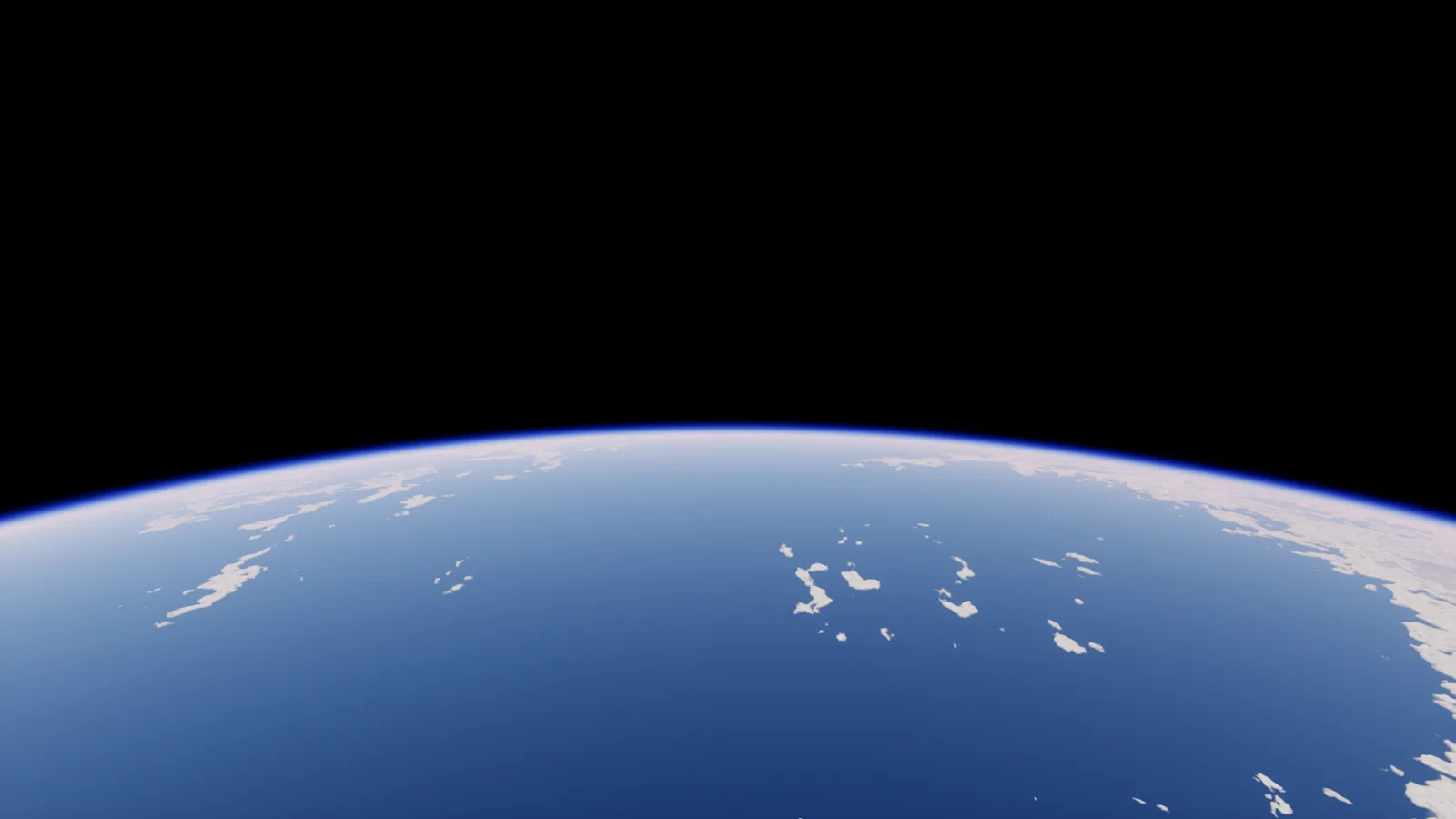
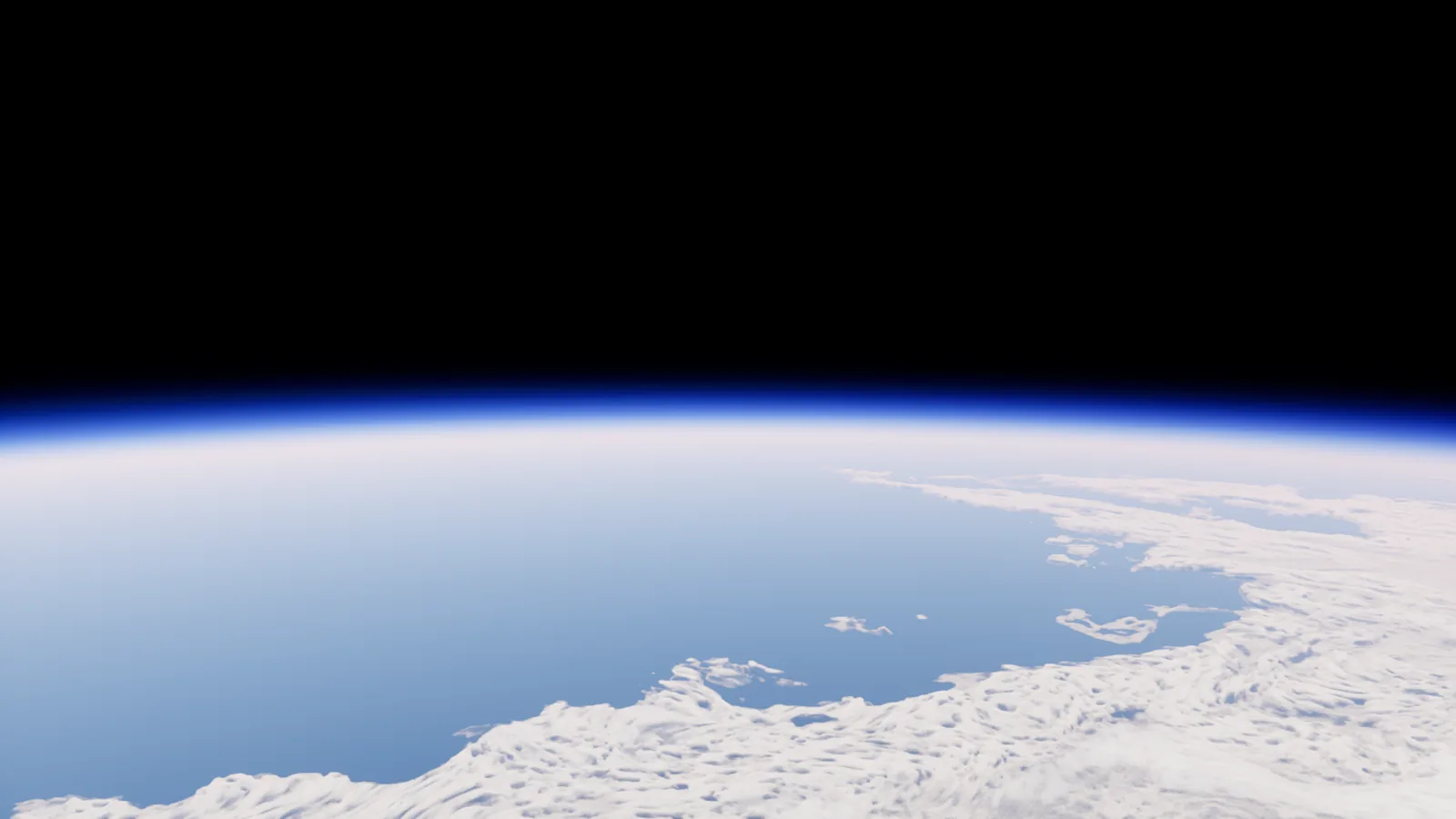
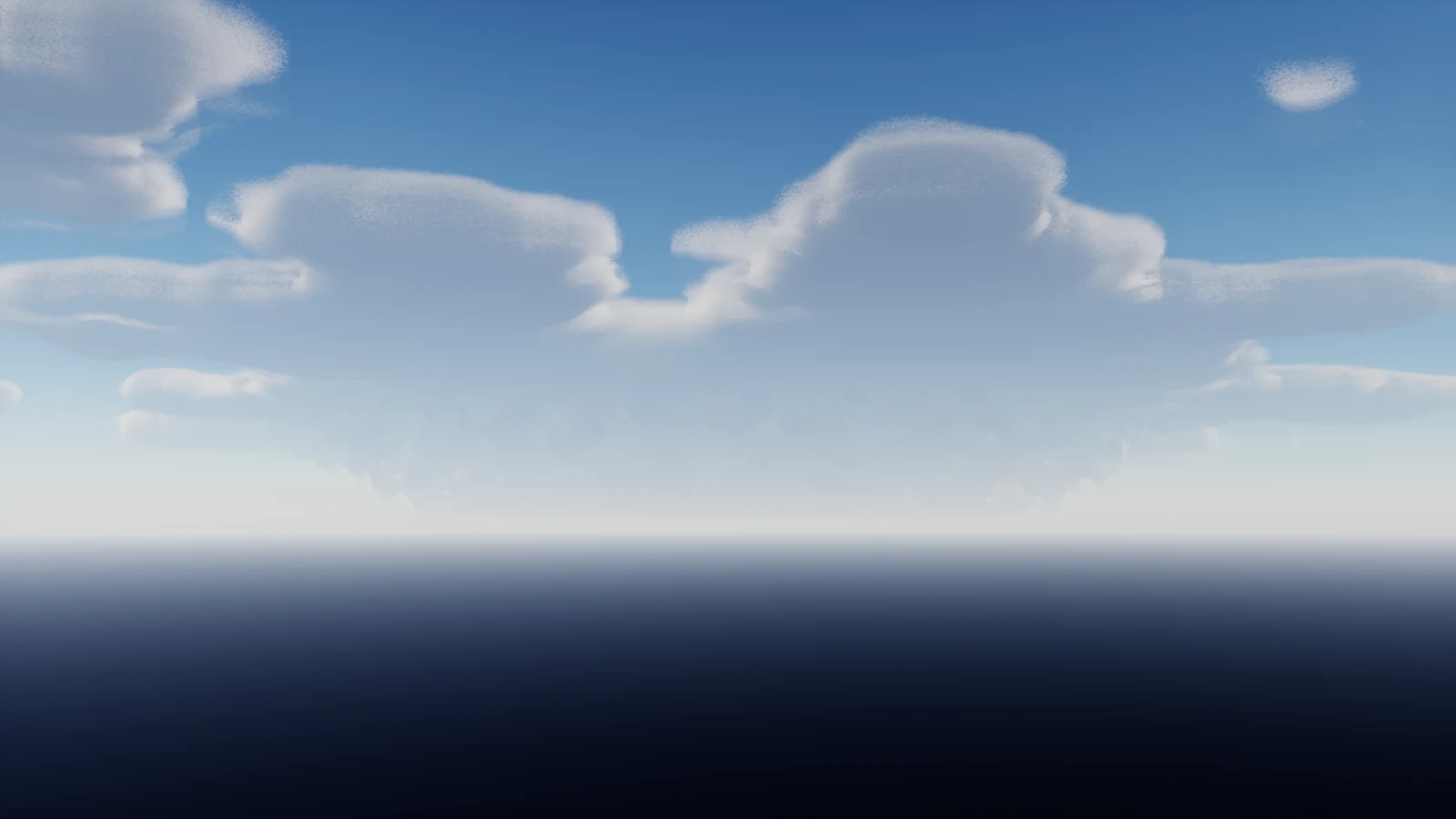
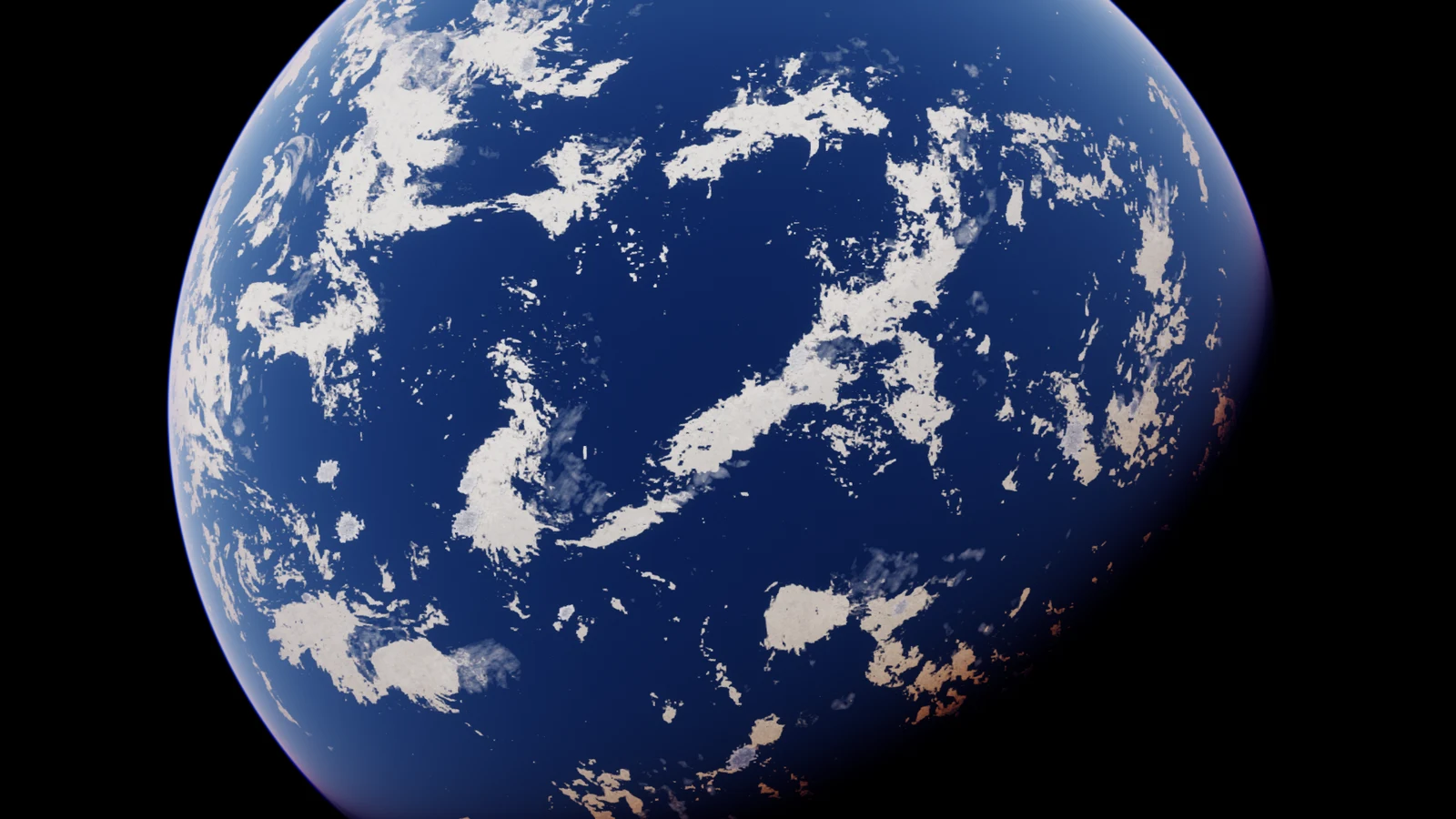
Captured in-engine on UE5.5, no post-production beyond a resize. Same planet, same weather field, four altitudes on the way down.

20,000 km — full disc
The whole weather field at once: wide bands of cloud with channels of open ocean between them.

400 km — orbital
The atmosphere's blue limb against space, with scattered cumulus clearing enough to show open ocean below.

60 km — descending
The same weather field, resolved down to the frayed, fibrous edge of each cloud mass.

Ground level
Looking toward the sun through the lower atmosphere, low on the horizon.
What's actually in the plugin.
Four layer types — a flat stratus deck, fair-weather cumulus, deep rain-bearing nimbostratus, and towering cumulonimbus with anvils — all grown from one shared convection field rather than four separate systems. Storms carry their own lightning, lit from inside the cloud.
Rayleigh scattering, Mie haze, an ozone-shaped layered absorber and a uniform gas absorber, each per kilometre. Fourteen presets — Earth-like, Mars, Venus, Titan, the four ice/gas giants, ocean, desert and ice worlds, a thin trace atmosphere, and vacuum — plus full manual override of every coefficient.
Coverage is driven by one weather field with cyclones, frontal bands and latitude banding for gas giants, so clear sky and solid overcast both actually occur. Paint coverage by hand on a 2,048×1,024 equirectangular map, or pin a thunderstorm exactly where you want one.
The same signed height field answers "how far above the ground, which way is up" for a planet's surface and for a flat map. Orbit and ground level read the same terrain, so nothing changes shape when you fly down to it.
Place a Welkin Star, pick a spectral type from O to M (or set temperature, radius and mass directly), and its colour comes out of the temperature — nothing is tinted by hand. Illuminance is physical: about 128,000 lux at one astronomical unit for a Sun-like star, falling off by the inverse square.
Any actor can orbit a star or another planet — moons around planets, stations around moons. Periods come from Kepler's third law and the star's mass, not a typed-in number, and position is a closed-form function of time: no integrator, no drift, and scrubbing time backwards works.
A body on a short orbit can move tens of thousands of kilometres a second. Close to a planet's surface the camera — and, optionally, nearby ships and stations — take the same step the planet just took, so the ground holds still under your feet instead of sliding out from under the world.
Doesn't use the engine's Volumetric Cloud or Sky Atmosphere, and doesn't write to project-wide CVars. Drop it into an empty UE5.5 project and it works; drop it beside a terrain or another atmosphere plugin and it still reads scene depth correctly rather than fighting for the sky.
Built for a world you can orbit, not only one you can stand on.
Most sky and cloud plugins are written for a flat level with one sun. This is a general description of that class of tool, not any specific product.
| AeroPlanet Volumetrics | Typical flat-world plugin | |
|---|---|---|
| Ground shape | Sphere or plane from the same height field — fly from orbit to the ground without the terrain changing shape. | Built for a flat level; a planet usually needs a second, separate system. |
| How it draws | A scene component. The raymarch runs right after the base pass, when scene depth is already correct. | A full-screen post-process pass painted over the finished frame. |
| Multiple skies in one scene | As many cloud and atmosphere components as the scene needs, sorted nearest-first. | Usually one sky per scene — a second planet means a second scene or a workaround. |
| Units | Lux, cd/m² and per-kilometre scattering coefficients throughout, end to end. | An arbitrary "brightness" or "density" slider with no physical anchor. |
| Day/night and orbits | A placeable star actor drives illumination, orbital periods and rotation from real quantities. | Usually out of scope — needs a separate time-of-day or orbit plugin. |
| Footprint in your project | Doesn't touch project CVars or engine sky systems; coexists with other terrain/atmosphere plugins. | Often configures engine-wide settings that other plugins then have to work around. |
Launching on Fab, in the Procedural Systems category.
AeroPlanet Volumetrics is not published yet — a visual issue is being fixed before launch. The prices below are the planned Fab listing; both tiers unlock the full plugin, and the difference is which of Fab's standard licence tiers applies to your use. Join the Discord to hear the moment it goes live.
Personal
$49.99
one-time, planned Fab price
For solo developers and small teams working on their own projects.
Notify me at launchProfessional
$104.99
one-time, planned Fab price
For studios and teams that fall under Fab's professional licensing tier.
Notify me at launchQuestions before launch?
The Discord server is where development updates, work-in-progress renders and support happen first. Email works too, for anything that needs to stay private.